 by John Patrick Schutz
Ever wonder why there’s a Nyack, Upper Nyack, South Nyack? Not to mention a Central Nyack and a West Nyack?
It can be confusing even to those of us who’ve lived here all of our lives. In a broad sense, we tend to think of Nyack as encompassing most of the mentioned locations — along with Grandview-on-Hudson, Upper Grandview and parts of Valley Cottage and Blauvelt! To obfuscate matters further: The zip code 10960 encompasses the villages of Nyack, Upper Nyack, South Nyack and Grandview-on-Hudson, along with the hamlets of Central Nyack and Upper Grandview and a tiny part of Blauvelt; Upper Nyack, Central Nyack and West Nyack are in Clarkstown while Nyack, South Nyack, and the two Grandviews are in Orangetown.
As for schools, Grandview-on-Hudson and Blauvelt are located in the South Orangetown School District, West Nyack and part of Central Nyack in the Clarkstown School District, while the rest of Central Nyack, Nyack, South Nyack and Upper Nyack and Valley Cottage are in the Nyack School District. Shall I get into which locations are served by Nyack Water and which by United Water? The number of cross-jurisdictions can be mind-boggling at times! Many events led to the breaking up of what in the days of New Netherland were the Nyack Patent and the Vreisendael Patent into the villages and hamlets we currently know.
One of the defining moments of division came in August of 1885 with the opening of the Upper Nyack Post Office. In 1870 the New York State Legislature passed a general act for the incorporation of villages, and by 1872 local Nyack businessmen had devised a plan to incorporate the Nyack area into a large village that would include all of the present day villages of Nyack, South Nyack and Upper Nyack along with most of Upper Grandview and the Clausland Mountain section of Blauvelt. By pulling in these outlying areas, the downtown could be improved and enhanced using the tax dollars of the property owners of the outlying areas (many of the residents of the downtown area were tenants and therefore did not pay property taxes). Garrett Sarvent of Upper Nyack (whom I suspect is a descendent of Phillip Sarvent, the Revolutionary War hero buried in the old Palmer cemetery) got wind of these intentions, and, upon gaining real proof that this was indeed the plan of the downtown business owners, planned a counter-offensive. In what amounted to almost complete secrecy for a political maneuver, the residents of Nyack north of the line between Clarkstown and Orangetown (near Sixth Avenue) plotted out their own village and incorporated as Upper Nyack in September of 1872, just 25 days before the original incorporation plans that included it in a future Nyack village came to fruition. So, when Nyack officially incorporated October 23, 1872, it was without its northern reaches.
To be fair, the residents of Upper Nyack had a point at the time. For instance, gas street lights and home gaslight service was available downtown starting in 1859 but not in Upper Nyack — nor anywhere else outside of downtown for that matter — and the taxes of the landowners in the outlying areas were going towards those amenities. During the rest of the 1870s, the residents south of downtown were facing the problems the residents north of downtown had elected to flee prior to incorporation. Finding all of their taxes going only to improve areas they did not live in, a movement to end incorporation was held, and on February 7, 1878 the original incorporated Village of Nyack ceased to exist. On May 25 of that year, the Village of South Nyack came into existence followed by a newly restructured Village of Nyack on February 27, 1883, consisting of just the downtown area and its associated residential section on the hillside above.
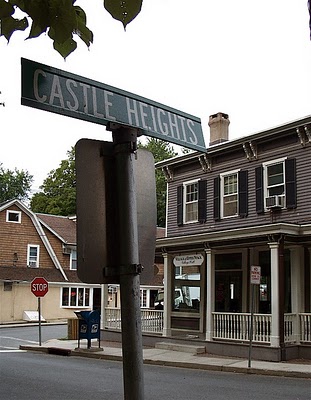
The opening of the Upper Nyack Post Office in August of 1885 firmly established Upper Nyack’s presence as an entity in and of itself. The streets of Upper Nyack had been macadamized (paved) and street lamps installed along Broadway. The lower taxes in Upper Nyack caught the attention of some businesses and first Post Master George C. Stevens could look out from the porch of the Post Office and see the offices of the Pacific Mail Company and the Main Offices of the Union Steamboat Company. Just down Castle Heights Avenue was the Van Houten Boatyard (later Petersen’s) and Upper Nyack settled in for a period of quiet prosperity.
What started out as a good idea back then when both Upper Nyack and South Nyack had business areas that helped pay for some of their individualized services may today seem like a liability. By the 20th Century, Upper Nyack had a thriving waterfront area that built, serviced, drydocked and docked boats, sloops, riverboats and ships, along with a number of small businesses scattered mostly along the main north-south corridors of Broadway, Midland and Highland Avenues (Route 9W). By mid-century, South Nyack had its own downtown with shops, restaurants, taverns, churches, cemeteries and even a house or two of ill-repute! The Nyack and Northern Railroad had a station in downtown South Nyack, along what is now the bike and jogging trail (a poor substitution, that). Both villages had commercial and residential tax payers. Unfortunately, the decline of the ice industry and the shipping industry would doom Upper Nyack’s shoreline businesses and a move toward residential-only meant all of the old multi-use business/residential properties scattered around the village were no more as soon as they sold to a new owner.
If Upper Nyack’s businesses succumbed to old age, South Nyack’s loss was more like losing a loved one to a sudden accident. The New York State Thruway obliterated most of what was the business district of South Nyack when it and the Tappan Zee Bridge were constructed, severing the village in two and leaving it without many opportunities for rateables and tax-paying businesses.
What had been a tax benefit in the late 19th century may no longer be so in the early 21st. With taxes rocketing throughout the country — but particularly here — the redundancy of village services that co-exist with or supersede town services add an additional burden on what are now primarily residential areas with no businesses to help share the tax burden. Still, I have the feeling that sentiment — and an unbelievably labyrinthine process to dissolve incorporation — will keep our villages separate for the foreseeable future.
John Patrick Schutz is a realtor for Rand Realty in Nyack, NY. You can read his blog posts at AtHomeInNyack. This story was originally published in 2011.
Photo: Upper Nyack Village Hall. Credit: Nyack Daily Snapshot
See also:
- Issue Of The Week: Consolidation, 8/22/2011
- To Be Or Not To Be: Upper Nyack As Hamlet, 12/14/2010
- Upper Nyack’s Independence Plan, 12/16/2010
- April 1: The Republic of Nyack Annexes Adjacent Villages, 4/1/2010