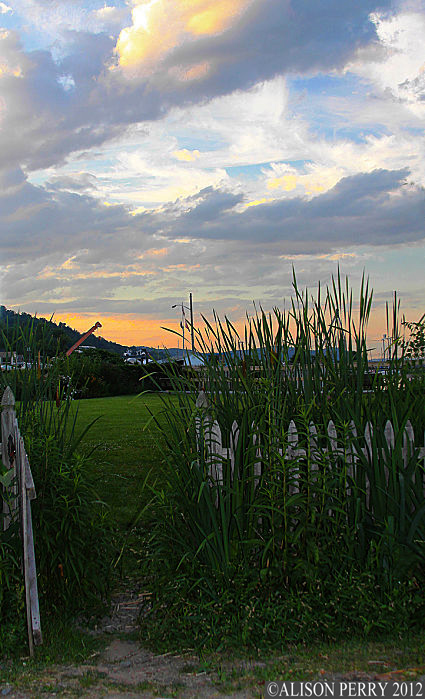
Shot at 1/125, F4.5 using Canon 28-135mm lens @ 28mm focal length
by Alison Perry
Storm clearings over the Hudson always bring a clarifying sharpness to the atmosphere. Having learned this along with the fact that incredible cloud formations and colorful sunsets occur then as well, I was prompted a few days ago to return to several spots along the riverfront south of Nyack. First to Sneden’s Landing, then a stop in Grandview, then on to Piermont because my instincts hinted the best was yet to come.
Turning left into the river front parking lot in Piermont, I made another left past the library to face north. I looked up to see a huge oval shaped cloud arching its way up over a lush patch of green in front of me called Parelli Park. More bands of lavender colored clouds just like it sifted in the distance over valley and hills above a cream sickle colored sunset. In front of me the mid summer park vegetation had overtaken the low picket fence with its unhinged gate weathered by time. A bit nostalgic perhaps, but also, a split second reminder that instances like this prompted the long tradition of American landscape painting beginning with the Hudson River School.
In another minute or two I would lose the last rays of sunlight on that arching cloud, so I decided to forgo setting up the tripod in favor of a hand held twilight exposure. The choice would cause loss of image sharpness in the clouds since I would focus on the fence and vegetation using a wider aperture to admit more light. I used the camera’s built in flash to provide a touch of fill light necessary to clarify the tall stalks of vegetation among the weathered pickets.
After making several horizontal shots along the perimeter of the fence, I shifted my focus to the open gate. Open gates can form a welcoming association, and are used by artists to that end, but in this instance, the gray fence helps separate the foreground from the background while allowing the eye to travel through it and up over the lush green lawn to that arching cloud I hoped to capture in time. For me this image beckons one to come in, stay a moment and take in the beauty of the Hudson River Valley.
In photography, shutter speed numbers combine with aperture or F-stop numbers to create an exposure. Shutter speed controls motion, while F-stops control the range of sharpness from front to back of your point of focus. The slower the shutter speed, the more noticeable the motion in your image. Generally speaking, using a wider/lower aperture number will decrease the range of sharpness and using a shutter speed of less than 1/125 or 1/1oo of a second will increase blur. Also, an aperture under F8 will significantly decrease image sharpness front to back of your point of focus.
Photographers keep three important considerations in mind regarding their equipment and time spent out in the field. The first is ISO rating. ISO is a film speed rating system. Cameras provide a range of ISO ratings, also known as speeds. You can change them according to the time of day and your shooting conditions. Speeds usually range between 100-25600 and are built into the camera’s digital imaging sensor. Used in conjunction with shutter speeds and apertures, ISO speeds affect pixilation and thus, image resolution. The higher the ISO speed or rating, the greater the increase in pixel structure, referred to as digital noise. The second consideration is Adobe Photoshop, a software application used to post process images. It provides a range of tools that allows photographers to enhance their images or fix images when technical and/or environmental problems are encountered in the field. For instance you can erase a pesky telephone line that got in the way. Third, is the quality of your equipment. Generally speaking, (because a poorly exposed or blurred image can still make a great artistic statement), the better your equipment and technical expertise, the less time you will spend later on post processing your images in Photoshop!
Alison Perry owns a Nyack-based photography business that combines architecture, landscape and formal space and strives to make personal art about time and place. Imagery is for sale through her website. She received BFA in Studio Art from SUNY Purchase and a graduate degree in Library Science from Long Island University. Previously, she worked in journalistic and editorial photography for several different national/regional newspapers in NYC, PA and CA. See examples of her work at http://alisonperry.photoshelter.com/index
See also:
- Postcard From New York on NyackNewsAndViews
- ExposureGuide.com
- CameraTown.com